In this guide
- Why recovery agents call in the first place
- What RBI rules say about recovery agents
- What a recovery agent can and cannot do
- How to handle a recovery call, step by step
- Where to complain if an agent harasses you
- Your duties as a borrower
- Checklist: what to do this week if recovery calls have started
- Rebuilding after a default
- Frequently asked questions
- Need help planning your next step?
Updated: 7 November 2026
A missed EMI is stressful. A phone call from a recovery agent can make it feel much worse, especially if the caller is rude, calls late at night or threatens to tell your family or office. Many borrowers do not know that recovery agents have to follow clear rules set by the Reserve Bank of India (RBI), and that the bank or NBFC that hired them stays responsible for how they behave. This guide explains what a genuine recovery agent can and cannot do, how to respond when calls start, and where to complain if the rules are broken.
Quick answer: A lender is allowed to recover its money, and a recovery agent may call, message or visit you to remind you about overdue dues. But RBI rules say agents must not threaten, abuse or use force, must not shame you in front of family, friends or colleagues, and should contact you only at reasonable hours. If an agent crosses the line, complain in writing to the lender's grievance officer. If the lender does not resolve it, you can approach the RBI Ombudsman. You still owe the money, so the best long-term step is to talk to the lender about a repayment plan.
This article is general information, not legal advice. For your own case, speak to a qualified lawyer.
Why recovery agents call in the first place
When an EMI is missed, the account becomes overdue. Most banks and NBFCs first send automatic reminders by SMS, e-mail or app notification. If the dues stay unpaid, the account is passed to a collections team. Many lenders use outside agencies for this work. These agencies are called recovery agents or collection agents.
Being contacted by an agent does not mean you have done something criminal. Not being able to repay a loan is usually a civil matter between you and the lender. We explain this in detail in Can Loan Defaulters Go to Jail in India? The lender's job is to recover the money through fair and lawful means, and the agent's job is to help it do that without harassment.
What RBI rules say about recovery agents
The RBI has issued instructions for banks and NBFCs that use recovery agents, along with a Fair Practices Code for lenders. In August 2022 it also issued a circular on the responsibilities of lenders employing recovery agents, which applies to banks and NBFCs. You can read the original circulars on the official RBI website. In simple words, the rules cover these points:
- The lender is responsible. A bank or NBFC cannot escape responsibility by saying "the agency did it". It must make sure its agents follow the rules.
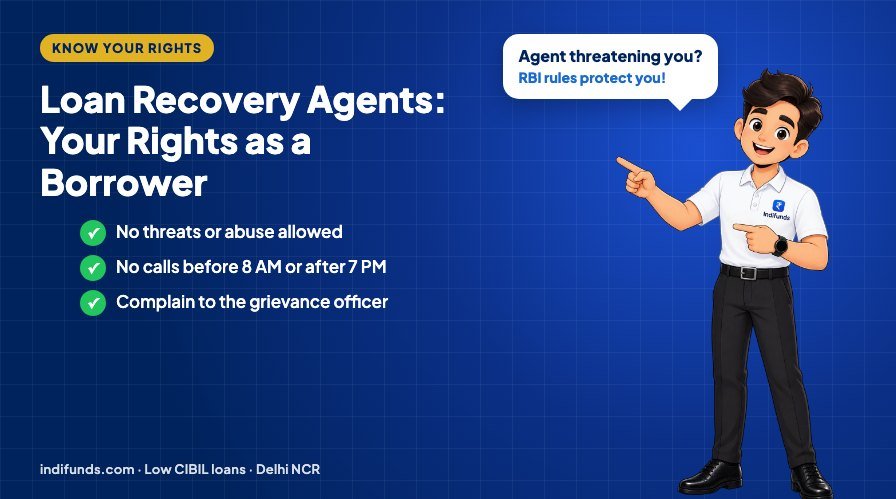
- No intimidation or harassment. Agents must not threaten, abuse or use physical force, whether in person, by phone or through messages.
- No public shaming. They must not humiliate you, intrude on the privacy of your family, friends or colleagues, or send offensive messages to them.
- Reasonable hours. Recovery calls should not be made at odd hours. The 2022 circular states that agents should not call borrowers before 8:00 a.m. or after 7:00 p.m.
- Proper identity. An agent should be able to show who they are and which lender they represent, and the lender should be able to confirm that the agency works for it.
- Grievance redressal. Every lender must have a grievance redressal system and a named grievance officer for complaints, including complaints about recovery.
Digital lending has its own extra rules, such as a Key Fact Statement that shows the recovery terms and a ban on using your phone contacts to harass you. Our guide to the RBI digital lending guidelines explains these.
What a recovery agent can and cannot do
| Allowed | Not allowed |
|---|---|
| Call or message you to remind you about overdue dues | Threats, abusive or vulgar language, or physical force |
| Visit you at a reasonable time to discuss repayment | Calling you before 8 a.m. or after 7 p.m. |
| Ask for a repayment date or a part payment | Calling or messaging your relatives, friends or colleagues to shame you |
| Explain the amount overdue and the charges in your loan documents | Posting about your loan on social media or sending edited photos |
| Tell you about the lender's lawful next steps, such as a legal notice | Falsely claiming to be police, a court officer or a government official |
| Accept payment through the lender's official channels | Asking you to pay cash or into a personal bank account or UPI ID |
One rule worth repeating: always pay only into the lender's official account, app or payment link, and keep the receipt. A payment made to an agent's personal account may never reach the lender.
How to handle a recovery call, step by step
1. Stay calm and confirm who is calling
Ask the caller for their full name, agency name and the lender they represent. Then check with the lender's official customer care number (from its website or your loan documents) that this agency is authorised for your account. Do not share OTPs, passwords or bank login details with anyone.
2. Confirm the amount you owe
Ask the lender, not the agent, for a written statement of the overdue amount, interest and charges. Compare it with your loan agreement and Key Fact Statement.
3. Be honest about what you can pay
If you cannot pay the full amount, say so and offer a realistic date or a part payment. Lenders often prefer a clear plan to silence. Ask whether a short break, a lower EMI with a longer tenure or a restructure is possible.
4. Keep a record of everything
Note the date, time, phone number and what was said in each call. Save SMS, WhatsApp messages and e-mails. Where the law allows, a call recording can also help. Records make a complaint much stronger.
5. Move to writing
Follow up important calls with an e-mail to the lender's official address. Written communication keeps both sides clear and creates proof of your good faith.
Where to complain if an agent harasses you
- Lender's grievance officer. Write to the lender's grievance redressal officer. Their contact details are on the lender's website and usually in the loan documents. Describe each incident with dates and attach your proof.
- RBI Ombudsman. If the lender does not reply within 30 days, or you are not happy with the reply, you can file a complaint under the RBI's Integrated Ombudsman Scheme on the RBI Complaint Management System. The service is free.
- Police. If there are threats of violence, physical force or abusive messages to your family, you can also file a police complaint. Keep copies of your evidence.
- Legal advice. If you receive a court notice or a legal notice, for example for a bounced cheque, do not ignore it. Speak to a lawyer and respond within the time given.
Complaining about harassment does not cancel the loan. It only stops unfair behaviour. You still need a plan to clear the dues.
Your duties as a borrower
Borrower rights come with responsibilities. Knowing both helps you deal with the lender from a strong position:
- Do not change your phone number or avoid every call. Silence usually leads to more calls and faster legal steps.
- Pay whatever you can, even if it is part of the EMI. It reduces the overdue amount and shows good faith.
- Do not give false information or fake documents. That can turn a civil matter into a criminal one.
- Read every settlement offer carefully. A settlement closes the account for less than you owe, but it is reported to credit bureaus. Our guide on loan settlement vs loan default explains the CIBIL impact.
- Avoid taking a new short loan only to pay an old one. That often makes the problem bigger.
Checklist: what to do this week if recovery calls have started
- List all your loans, EMIs, due dates and overdue amounts in one place.
- Call each lender's official customer care and ask for a written statement of dues.
- Confirm that the agency calling you is authorised by the lender.
- Offer a realistic repayment plan in writing.
- Save every call log, message and receipt.
- Complain in writing to the grievance officer if any agent breaks the rules.
- If you have several costly loans, check whether combining them into one loan with a single EMI could lower your monthly burden. Read our guide on debt consolidation with a low CIBIL score.
Rebuilding after a default
Once the overdue amount is cleared or settled, the focus shifts to repairing your credit history. On-time payments on any remaining loans, low credit card usage and no new defaults help your score recover over time. Our step-by-step guide on how to improve your CIBIL score after a loan default explains what to do month by month. If you want to know how long an old default stays relevant, read what happens after 7 years of not paying a debt in India.
Frequently asked questions
Can a recovery agent come to my house or office?
An agent may visit you at a reasonable time to discuss repayment, and should identify themselves and the lender they represent. They must not threaten you, create a scene or embarrass you in front of family members or colleagues. If that happens, complain in writing to the lender.
Can recovery agents call my family or friends?
RBI rules say agents must not intrude on the privacy of your family, referees or friends, or shame you before them. Digital lending rules also stop lenders and apps from using your phone contacts to harass you. Save any such messages as proof for your complaint.
At what time can recovery agents call?
RBI's 2022 circular on recovery agents states that borrowers should not be called before 8:00 a.m. or after 7:00 p.m. Calls outside these hours can be reported to the lender's grievance officer.
Can I be arrested for not paying a personal loan?
Not being able to repay is generally a civil matter, so a lender cannot have you arrested only for non-payment. A criminal case can arise in specific situations, such as a bounced cheque that is not paid after a legal notice, or fraud. Read our detailed guide and speak to a lawyer about your own case.
I defaulted on a personal loan many years ago. Can agents still contact me?
Lenders may still try to recover old dues, and the default can remain in your credit report history. Do not ignore a notice. Ask the lender for a written statement and get legal advice on your options. Our article on what happens after 7 years of not paying debt explains the credit report side.
Can I get a new loan while recovery calls are going on?
It is harder, because active overdue accounts weigh heavily in a lender's decision. Focus first on a repayment plan with your current lender. Once your situation is stable, a lender may consider your current income and repayment capacity. Approval is never guaranteed and is the lender's final decision.
Need help planning your next step?
Indifunds is based in Noida and helps salaried people in Delhi NCR understand their loan options, including borrowers with a low CIBIL score. We do not charge any fee before approval, and we never ask you to pay money into a personal account. If you want to talk about a manageable way forward, call our support team on 8595702470 or contact us here.
*This article is for general information only and is not legal or financial advice. Loan approval, amount, interest rate and tenure are subject to eligibility criteria, verification and the lender's final approval. All terms and charges are governed by the loan documents.
Check your loan eligibility
Salaried in Delhi NCR? Low CIBIL score or a past rejection? Our team will assess your profile.
Takes about 2 minutes. No upfront charges.