
In this guide
Updated: November 2026 – facts checked and related guides added.
Digital loans are fast and convenient, but some apps have charged hidden fees, misused personal data and harassed borrowers. To protect customers, the Reserve Bank of India (RBI) has issued rules for digital lending that apply to banks, NBFCs and the apps they work with. This guide explains the key rules in simple language and how you can use them to borrow safely in 2026.
Quick answer: Under RBI's digital lending rules, loans must be given and repaid directly between your bank account and the regulated lender's account; you must receive a Key Fact Statement showing the annual percentage rate (APR) and all charges before you sign; apps cannot freely access your contacts or photos; you get a cooling-off period to exit the loan; and every lender must have a grievance officer. If a complaint is not resolved, you can approach the RBI Ombudsman.
Why RBI made these rules
- Hidden processing fees and very high effective interest rates.
- Apps collecting contacts, photos and messages and using them for harassment.
- Unclear information about who the actual lender is.
- Abusive recovery practices.
The key rules, simplified
| Rule | What it means for you |
|---|---|
| Direct disbursal and repayment | Money comes straight to your bank account from the regulated lender, and you repay to the lender's account, not to an app's pool account. |
| Key Fact Statement (KFS) | Before signing you get a standard document showing the APR, all fees, the EMI schedule and recovery terms. |
| All-inclusive cost (APR) | Fees cannot be hidden; anything not in the KFS should not be charged. |
| Cooling-off period | You can exit the loan within the stated period by repaying the principal and proportionate APR, without a penalty. |
| Data privacy | Apps need your consent, should collect only necessary data and cannot freely access contacts, media or call logs. |
| No automatic credit increases | Your credit limit cannot be raised without your explicit consent. |
| Grievance redressal | Every lender and app must name a grievance officer; unresolved complaints can go to the RBI Ombudsman. |
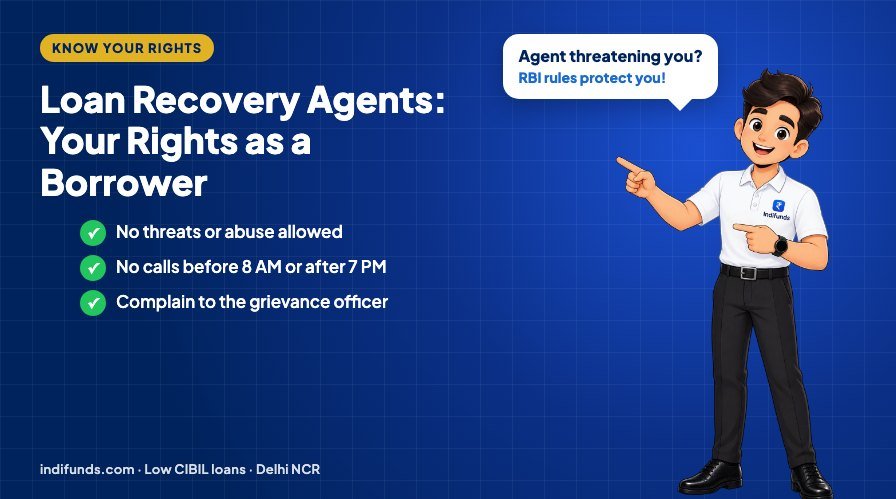
| Fair recovery | Recovery agents must follow RBI conduct rules; threats and shaming are not allowed. |
What changed in 2025
In May 2025 the RBI issued the Reserve Bank of India (Digital Lending) Directions, 2025. They bring the earlier digital lending guidelines into one set of rules for banks, NBFCs and the loan service providers they work with. The main borrower protections stay the same: the loan is paid into and repaid from your own bank account with the regulated lender, you receive a Key Fact Statement before you sign, you get a cooling-off period to exit the loan, and every lender must have a grievance redressal officer.
Since July 2025 the RBI also publishes a public list of the digital lending apps that regulated lenders have reported. Before you share documents with any loan app, check that the app appears on that list on the RBI website (rbi.org.in).
How to check whether a lender or app is genuine
- Find the name of the regulated lender (bank or NBFC) behind the app; it should be shown in the app and the loan agreement.
- Check that the NBFC is registered with the RBI on the RBI website.
- Look for a Key Fact Statement before you accept.
- Check the grievance officer's name and contact details.
- Read the app permissions; refuse access to contacts and photos.
Warning signs to avoid
- Requests for an "advance fee" or "file charge" before approval.
- No written agreement or no KFS.
- Payments asked into a personal account or UPI ID.
- Threats or messages to your contacts.
What to do if you face harassment or unfair charges
- Keep screenshots, call records and payment receipts.
- Complain in writing to the lender's grievance officer.
- If not resolved within 30 days, file a complaint on the RBI's complaint management system (Integrated Ombudsman).
- For threats or fraud, report to the police cyber cell.
How Indifunds follows fair practices
Indifunds is a loan facilitator based in Noida (a unit of Devdhan Narayana Finserv Pvt Ltd, CIN U66190UP2024PTC210110) that works with lending partners. We do not collect any fee before approval, we explain all charges before disbursal, the loan agreement is signed with the lender, and money is paid directly into your bank account. You can reach our grievance redressal team at any time. Read more in responsible lending and customer awareness.
Related guides
- Loan apps for CIBIL defaulters: safe vs fake
- Loan fee scam check: is this loan message real?
- Personal loan foreclosure charges and RBI rules
- Can loan defaulters go to jail in India?
Frequently asked questions
Do the RBI rules apply to every loan app?
They apply to banks and NBFCs regulated by the RBI and to the apps and service providers they work with. Apps that are not linked to a regulated lender are outside this system, which is why you should avoid them.
What is APR?
The annual percentage rate is the all-in yearly cost of the loan, including interest and fees, so you can compare offers fairly.
Can an app access my contact list?
Regulated lenders and their apps should not access your contacts or media for lending purposes. Deny such permissions.
Can I cancel a digital loan after taking it?
Yes, within the cooling-off period stated in your Key Fact Statement, by repaying the principal and the proportionate cost.
Check your loan eligibility
Salaried in Delhi NCR? Low CIBIL score or a past rejection? Our team will assess your profile.
Takes about 2 minutes. No upfront charges.