In this guide
- Where does the "defaulter list" idea come from?
- Myth vs fact: what is actually on your record
- How a missed loan really shows on your credit report
- A simple example: same "defaulter", two very different reports
- What lenders look at after a default
- What to do if you think you are "on the list"
- Be careful with "we will remove your name" offers
- Frequently asked questions
- Worried about a past default?
Updated: 15 November 2026
"My name is in the CIBIL defaulter list, so no one will give me a loan." We hear this line from borrowers almost every day. It usually comes after a few missed EMIs, a credit card that went unpaid, or a call from someone who offers to "remove your name from the list" for a fee. Before you believe it, or pay anyone, it helps to know what a credit bureau actually keeps about you.
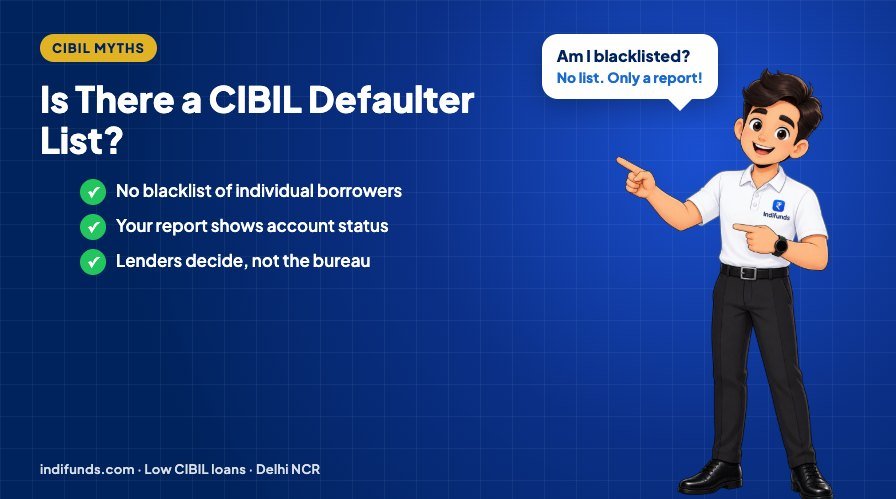
Quick answer: No. There is no "CIBIL defaulter list" or blacklist of individual borrowers. A credit bureau does not label anyone a defaulter and does not approve or reject loans. It keeps a credit report: your loans and cards, month-by-month payment history and the status of each account, exactly as reported by your lenders. A missed or unpaid loan shows as late payments or as a status such as "Settled" or "Written-off" on that one account. Each lender then reads the report and takes its own decision.
Where does the "defaulter list" idea come from?
There are three reasons the myth is so common.
- Loose language. When a lender says "your CIBIL is bad", people hear "you are blacklisted". In reality the lender has only seen late payments or a poor account status on your report.
- Lists that do exist, but for a different purpose. Credit bureaus publish lists of suit-filed accounts: borrowers against whom lenders have filed a recovery suit for dues of ₹1 crore and above, and wilful defaulters of ₹25 lakh and above. These are mostly large business accounts. A salaried person who missed a few personal loan or credit card payments is not on any such list.
- Agents who profit from fear. "CIBIL repair" agents use the word "list" because it sounds like something a payment can fix. It cannot. More on this below.
Myth vs fact: what is actually on your record
| What people believe | What is true |
|---|---|
| CIBIL keeps a list of defaulters and my name is on it. | CIBIL keeps a credit report for every borrower, good or bad. There is no separate list of individual retail defaulters. |
| CIBIL rejected my loan. | A bureau never approves or rejects a loan. The lender decides, using your report, income and its own policy. |
| Once a defaulter, always a defaulter. | Your report is updated regularly. Newer on-time payments are added and older months move out of the payment history shown. |
| If I pay the old dues, the record is deleted. | The account is not deleted. Its status changes (for example to "Closed" with zero balance), which reads far better than an unpaid account. |
| An agent can remove my name for a fee. | Only the lender that reported the account can change correct information. Genuine errors can be disputed by you directly, free of cost. |
| Every lender treats a past default the same way. | Policies differ. Some lenders decline, others look at how old the default is and how you have paid since. |
How a missed loan really shows on your credit report
Instead of a list, your report has a section for each loan and credit card. Three things in that section tell the story of a default.
1. Days Past Due (DPD)
For every month, the lender reports how many days late your payment was. "000" or "STD" means paid on time. Numbers such as 030, 060 or 090 mean the payment was that many days overdue. The report shows up to 36 months of this history, so one late month and twelve late months look very different.
2. Account status
If a loan is not repaid in the normal way, the lender may report a status such as "Settled" (closed for less than the full amount), "Written-off" (the lender has stopped expecting regular repayment and marked it as a loss in its books) or "Suit filed". A fully repaid loan simply shows as closed with no such remark. We explain each term in our guide on how to read your CIBIL report, and the difference between the two most common ones in loan settlement vs loan default.
3. Amount overdue
The report also shows the current balance and the overdue amount on each account. An old default with zero overdue reads differently from one where money is still pending.
These entries are what people call "being on the list". They can stay visible for several years; see what happens after 7 years of not paying a debt for the timeline.
A simple example: same "defaulter", two very different reports
Take two salaried borrowers in Noida. Both missed EMIs on a ₹2,00,000 personal loan during a job loss in 2024, and both call themselves "CIBIL defaulters".
| What the report shows | Borrower A | Borrower B |
|---|---|---|
| Old loan today | Paid in full later; status "Closed", overdue ₹0 | Still unpaid; status "Written-off", overdue ₹64,000 |
| Last 12 months on other accounts | All payments on time | Two credit card payments late |
| Loan applications in the last 3 months | 1 | 7 on different apps |
| How a lender is likely to read it | A past problem that has been cleared, followed by a clean track record | An open problem, with fresh signs of stress |
The figures are only an illustration, but the point is real: there is no single "defaulter" tag. What a lender sees is how big the problem was, whether it is still open, and what you have done since.
What lenders look at after a default
- Is the old account still unpaid? An open overdue amount is the biggest hurdle.
- How old is the default? A problem from three years ago weighs less than one from three months ago.
- Your payments since then. A run of on-time payments on any loan or card helps the most.
- Income and job stability. A regular salary credited to your bank account and time spent with your current employer.
- Existing EMIs. Whether your salary leaves room for one more EMI.
- Recent enquiries. Many applications in a short time suggest urgency.
This is why some borrowers with a past default do get a loan and others do not. Our article Can CIBIL defaulters get a loan? covers the realistic options.
What to do if you think you are "on the list"
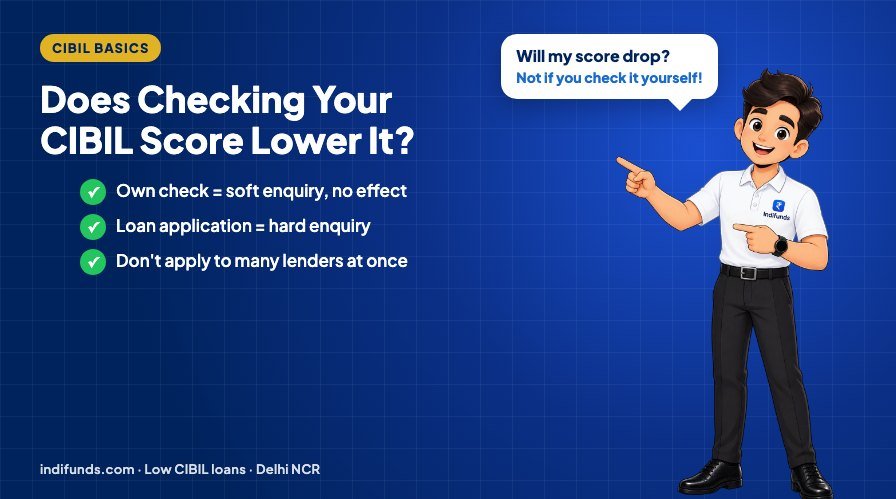
- Get your own report. Every credit bureau must give you one free full credit report each year. Checking it yourself does not affect your score. Here is how to check your CIBIL score for free.
- Find the exact account. Note the lender name, the status and the overdue amount. Often the "list" turns out to be one old credit card or a small app loan.
- Check that it is correct. If the account is not yours, or a loan you repaid still shows as overdue, raise a dispute on the bureau's website. It is free. The bureau checks with the lender, and under RBI rules a complaint should be resolved within 30 days.
- If it is correct, deal with the lender. Pay the pending amount if you can and ask for a no-dues letter. Check your report again after a few weeks to see that the status has been updated.
- Build a fresh track record. Pay every current EMI and card bill on time and avoid applying everywhere at once. Our step-by-step guide on improving your CIBIL score after a default explains this in detail.
Be careful with "we will remove your name" offers
No agent, app or company can delete correct information from your credit report. Anyone who asks for an upfront fee to "clear your name from the CIBIL defaulter list" is selling something that does not exist. The only genuine routes are the two above: a free dispute for wrong entries, and repayment plus time for correct ones. If someone has already taken money from you this way, you can report it on the national cyber crime helpline 1930 or at cybercrime.gov.in.
Frequently asked questions
Is there a CIBIL defaulter list?
No. CIBIL and the other credit bureaus do not keep a defaulter list or blacklist of individual borrowers. They keep a credit report with the payment history and status of each loan and credit card, as reported by lenders.
How can I check if my name is in the CIBIL defaulter list?
There is no list to check. Download your own credit report and look at each account for late payments (DPD) or a status such as Settled or Written-off. That is the record lenders see.
Can my name be removed from the CIBIL defaulter list?
Since there is no list, there is nothing to remove a name from. Wrong entries can be corrected through a free dispute with the credit bureau. Correct entries change only when the lender reports an update, for example after you repay the dues.
Can a CIBIL defaulter get a loan again?
It is possible, but never certain. Lenders look at whether the old dues are cleared, how old the default is, your payments since then and your current income. The final decision is always the lender's.
How long does a default stay on my credit report?
Payment history is shown month by month for up to 36 months, and account details such as a Settled or Written-off status can remain visible for several years. Its effect on lending decisions reduces as you add newer on-time payments.
Does paying off the old loan clear my record at once?
No. The account stays on the report, but its status and overdue amount are updated after the lender reports the payment. A cleared account is viewed much more favourably than an unpaid one.
Worried about a past default?
Indifunds is based in Noida and works with salaried people in Delhi NCR, including those with a low CIBIL score or a past default. Our team can look at your profile and tell you honestly which option, if any, suits you right now. We do not promise approval and we do not charge any fee before approval. See our personal loan for salaried CIBIL defaulters page, check your eligibility, or call our support team on 8595702470.
*This article is for general information only and is not financial or legal advice. Loan approval, amount, interest rate and tenure are subject to eligibility criteria, verification and the lender's final approval. All terms and charges are governed by the loan documents.
Check your loan eligibility
Salaried in Delhi NCR? Low CIBIL score or a past rejection? Our team will assess your profile.
Takes about 2 minutes. No upfront charges.