In this guide
- What is a salary advance?
- What is a personal loan?
- Salary advance vs personal loan: side-by-side comparison
- The real difference: what repayment does to your next salaries
- When a salary advance is the better choice
- When a personal loan is the better choice
- Decision checklist: answer these five questions
- With a low CIBIL score, which one is easier?
- Mistakes to avoid
- Frequently asked questions
- Not sure which one fits you?
Updated: 18 November 2026
Your salary comes on a fixed date, but a hospital bill, a rent deposit or a school fee does not wait for it. When you need money before payday, two options usually come up: a salary advance or a personal loan. Both are meant for salaried people, both can be applied for online, and both are loans. The difference is in how much you can borrow and, above all, how hard the repayment hits your next few salaries.
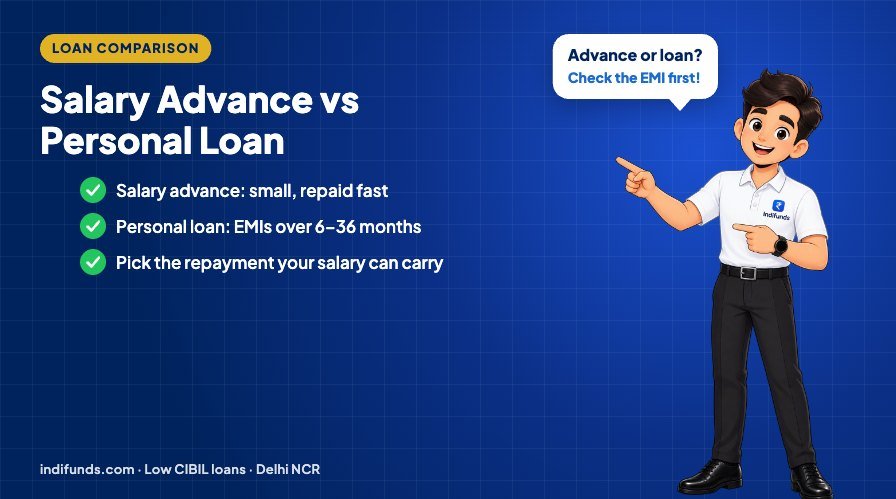
Quick answer: A salary advance is a smaller, short-term loan linked to your salary cycle, so it is repaid quickly and takes a big bite out of the next one or two salaries. A personal loan is larger and is repaid in monthly EMIs over a longer tenure (6 to 36 months at Indifunds), so each month's repayment is smaller, but you pay interest for longer. Choose a salary advance for a small gap you can clear soon; choose a personal loan when repaying quickly would leave you short again.
What is a salary advance?
The term is used for two different things, and it helps to separate them:
- Employer salary advance: your company pays part of your coming salary early and deducts it later through payroll. It is an arrangement between you and your employer, often with no interest, and it does not appear on your credit report. Not every employer offers it, and the amount is usually limited.
- Salary advance loan: a short-term loan from a bank or NBFC, given to salaried people on the strength of their monthly income. It carries interest and charges, it is repaid on a short schedule linked to your salary, and it is reported to credit bureaus like any other loan.
In this guide, "salary advance" means the second one: the loan. At Indifunds, a salary advance loan of ₹30,000 to ₹1 lakh* can be explored by salaried employees in Delhi NCR.
What is a personal loan?
A personal loan is an unsecured loan you repay in fixed monthly EMIs. You do not pledge any asset, and you can use it for most genuine personal needs. Because the repayment is spread over months, the amount can be larger. Through Indifunds, salaried applicants in Delhi NCR can explore a personal loan of ₹50,000 to ₹5 lakh, and up to ₹10 lakh in special cases for strong profiles*, with a tenure of 6 to 36 months.
Salary advance vs personal loan: side-by-side comparison
| Point | Salary advance loan | Personal loan |
|---|---|---|
| Amount at Indifunds* | ₹30,000 to ₹1 lakh | ₹50,000 to ₹5 lakh (up to ₹10 lakh in special cases) |
| Tenure | Short, linked to your salary cycle | 6 to 36 months |
| Repayment | Large amounts from the next one or few salaries | Fixed monthly EMI |
| Pressure on next salary | High | Low to moderate |
| Total interest paid | Lower in rupees, because the money is borrowed for a short time | Higher in rupees, because the money is borrowed for longer |
| Best for | A small gap you can clear within a salary or two | A bigger need, or one you need months to repay |
| Credit report | Reported (if from a lender); on-time repayment helps | Reported; a long record of on-time EMIs helps more |
| Who can apply at Indifunds | Salaried, ₹35,000+ monthly in-hand salary, age 23 to 55, living in Delhi NCR | |
*Subject to eligibility, verification and the lender's final approval.
The real difference: what repayment does to your next salaries
Most comparisons stop at "salary advance is short, personal loan is long". The more useful question is: how much of your salary will go out every month, and what is left for rent, groceries and existing EMIs? A loan that is cheap in total but eats 70% of your salary can push you straight into a second loan.
Worked example: ₹60,000 needed on a ₹40,000 salary
Say your in-hand salary is ₹40,000 and you already pay an EMI of ₹4,000. You need ₹60,000 for a medical bill. To keep the maths fair, the table uses one illustrative rate of 2% a month (24% a year, reducing balance) for every tenure. This is only an assumption for the calculation, not an Indifunds or lender rate; your actual rate and charges depend on your profile and the lender.
| Repay over | Monthly repayment | Total interest | New repayment as % of salary | All EMIs as % of salary |
|---|---|---|---|---|
| 2 months | ₹30,903 | ₹1,806 | 77% | 87% |
| 3 months | ₹20,805 | ₹2,416 | 52% | 62% |
| 6 months | ₹10,712 | ₹4,269 | 27% | 37% |
| 12 months | ₹5,674 | ₹8,083 | 14% | 24% |
| 24 months | ₹3,172 | ₹16,134 | 8% | 18% |
Illustrative figures, rounded to the nearest rupee, before any processing fee or other charges. Use the EMI calculator with your own numbers.
What the table shows:
- Repaying in 2 months costs the least interest, but leaves you about ₹5,000 a month to live on. Most people in that position borrow again, which is how a debt cycle starts.
- Stretching to 24 months makes each EMI small, but the interest is almost nine times the 2-month figure.
- For this salary, 6 to 12 months is the balanced zone: total EMIs stay at roughly a quarter to a third of salary, and the interest stays reasonable.
So the right product is the one whose repayment fits your budget, not the one that sounds fastest. If ₹60,000 has to be cleared in one or two salaries, a salary advance only makes sense if you have other money coming in, such as a bonus or a refund. Otherwise a personal loan with a 6 to 12 month tenure is the safer choice.
When a salary advance is the better choice
- The amount is small compared with your salary, and you can repay it within the short tenure without cutting essentials.
- You know money is coming soon: an annual bonus, an incentive, a refund or a matured deposit.
- You want the loan to be over quickly and keep the total interest low.
- Your existing EMIs are low, so one tight month will not cause a missed payment.
When a personal loan is the better choice
- You need more than ₹1 lakh, or more than one month's salary.
- Repaying in one or two salaries would leave you short for rent, school fees or other EMIs.
- You want to replace several small app loans or card dues with one EMI. A single, planned EMI is easier to track than many short due dates.
- You want to rebuild your credit record: 12 or more months of on-time EMIs build a stronger history than one short loan.
Not sure where you stand? Read the personal loan eligibility guide for salaried people in Delhi NCR.
Decision checklist: answer these five questions
- How much do you really need? Up to about one month's salary points to a salary advance; more than that points to a personal loan.
- When can you repay without borrowing again? If the honest answer is "in a few months", choose an EMI loan.
- What will all your EMIs add up to? Add the new repayment to your current EMIs and card dues. If the total is close to half your salary or more, reduce the amount or extend the tenure.
- Is extra money coming soon? A known bonus or refund makes a short salary advance easier to clear.
- What does the Key Fact Statement say? Before you sign, compare the total amount payable, all charges and the annual percentage rate (APR) in the KFS. Compare the total, not just the monthly figure.
With a low CIBIL score, which one is easier?
Neither product skips the credit check. Regulated lenders look at your credit report for both, so be wary of anyone who promises a loan "without CIBIL check". What a low score changes is how closely the lender looks at the rest of your profile: your current salary, how stable your job is, your existing EMIs and how your repayments have looked since the old default.
- A smaller amount is sometimes easier to get approved, because it is easier to repay from current income. That is one reason people with a low score look at salary advances. Read more in salary advance loan with a low CIBIL score.
- A personal loan for a low-CIBIL profile is assessed mainly on salary and repayment capacity. The amount may be lower than you asked for, and the lender may ask for more documents.
- In both cases, applying to many lenders at once adds hard enquiries to your report. Check your eligibility first and apply where your profile fits.
Mistakes to avoid
- Choosing by monthly figure alone. Always look at the total amount you will repay.
- Taking a salary advance to repay another salary advance. If you are rolling over short loans, a single EMI loan is usually the way out. See salary overdraft vs personal loan vs credit line for other structures.
- Paying a fee before approval. A genuine lender or facilitator does not ask for a "file charge" or "insurance fee" before your loan is approved. Learn how to spot an advance-fee scam.
- Borrowing more than the need. A bigger approval feels good, but every extra rupee costs interest.
Frequently asked questions
What is the difference between a salary advance and a personal loan?
A salary advance loan is a smaller, short-term loan repaid quickly from your next salary or few salaries. A personal loan is a larger, unsecured loan repaid in fixed monthly EMIs over a longer tenure. The salary advance costs less interest in total but puts more pressure on your next salaries.
Which is cheaper, a salary advance or a personal loan?
For the same rate, the shorter loan costs less interest in rupees because you borrow for less time. But rates and charges differ by product and lender, so compare the total amount payable and the APR shown in the Key Fact Statement before you decide.
Is a salary advance loan RBI approved?
RBI does not approve individual loan products for borrowers. A salary advance loan should come from an RBI-regulated bank or NBFC, or through a platform working with one, and it must follow RBI's lending rules, including giving you a Key Fact Statement before you sign. An advance from your own employer is a payroll arrangement, not a loan from a lender.
Does a salary advance affect my CIBIL score?
A salary advance loan from a lender is reported to credit bureaus. Repaying on time can help your record; a late or missed repayment will hurt it. An advance from your employer is not a credit product and is not reported.
Can I get a salary advance or personal loan with a low CIBIL score?
You can apply for both. A low score does not automatically mean rejection, but the lender will look closely at your salary, job stability and existing EMIs, and the final decision is always the lender's. At Indifunds, salaried applicants in Delhi NCR earning ₹35,000 or more a month can be assessed for both.
Can I take a personal loan to close a salary advance?
Yes, if the lender approves it, and it can make sense when the short repayment is too heavy. Make sure the new EMI fits your budget and that you do not take another short loan afterwards.
Not sure which one fits you?
Indifunds is a Noida-based loan facilitator that helps salaried people in Delhi NCR, including those with a low CIBIL score or a past rejection, apply for salary advance loans and personal loans through its lending partners. Tell us how much you need and when you can repay, and our team will suggest the option that fits your salary. There is no fee before approval. Check your eligibility, read about personal loans in Noida, or call our support team on 8595702470.
*This article is for general information only and is not financial advice. Loan approval, amount, interest rate and tenure are subject to eligibility criteria, verification and the lender's final approval. All terms and charges are governed by the loan documents.
Check your loan eligibility
Salaried in Delhi NCR? Low CIBIL score or a past rejection? Our team will assess your profile.
Takes about 2 minutes. No upfront charges.