In this guide
- Do loan apps really give loans to CIBIL defaulters?
- Safe app vs risky app: how to tell the difference
- How to check a loan app in 5 minutes
- Why short "7-day" loan apps hurt low-score borrowers
- What to do if a loan app harasses you
- A safer route for salaried borrowers in Delhi NCR
- Frequently asked questions
Updated: 26 October 2026
If your CIBIL score is low or you have a past default, loan apps can look like the only way out. Many of them really do lend to low-score borrowers. But this is also the space where fake apps, hidden charges and harassment are most common. This guide shows you how to check any loan app in a few minutes before you share your documents or pay anything.
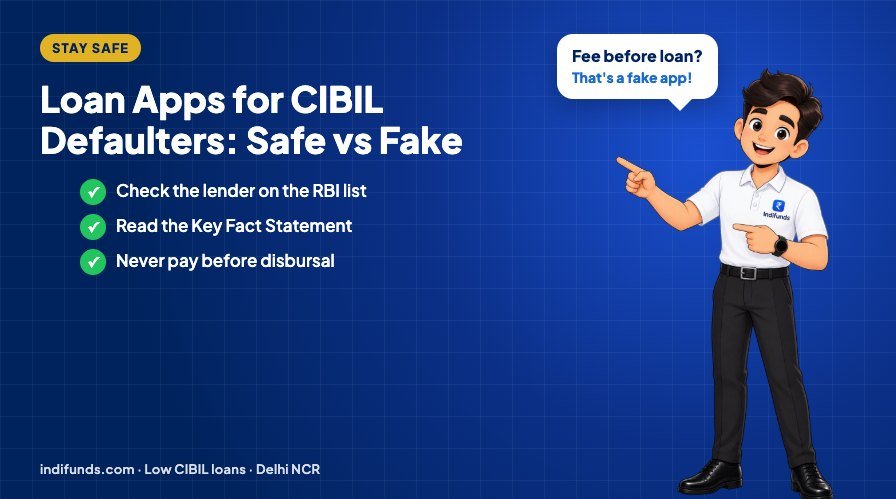
Quick answer: A loan app is safe only if a bank or an RBI-registered NBFC stands behind it. Check the app on the RBI's list of digital lending apps, read the Key Fact Statement before you accept, and make sure the money comes straight into your bank account. Never pay any fee before the loan is disbursed, and never give an app access to your contacts or photo gallery.
Do loan apps really give loans to CIBIL defaulters?
Some do. Lenders that work with low scores look more at your current salary, how regularly it reaches your bank account and your existing EMIs. The usual trade-off is a smaller amount, a shorter tenure and a higher interest rate than a bank loan.
What you should not believe is "guaranteed approval" or "no checks at all". A genuine lender always checks your identity and your income. An app that promises a loan without any checks is usually planning to make money from fees, penalties or your data instead.
Safe app vs risky app: how to tell the difference
| Check | Safe app | Risky or fake app |
|---|---|---|
| Lender behind the app | Shows the name of the bank or RBI-registered NBFC | No lender name, or a name you cannot find anywhere |
| RBI list of lending apps | App is listed against its bank or NBFC | Not listed |
| Fees | All charges shown in a Key Fact Statement before you accept | Asks for "processing", "file" or "insurance" fee before disbursal |
| Where the money comes | Directly into your own bank account | Through a third-party wallet or another person's account |
| Phone permissions | Only what KYC needs (camera, location), with your consent | Wants your contacts, photos or call logs |
| Tenure and amount | Clear tenure, clear EMI or repayment date | Very short tenure (like 7 days) with a much smaller amount credited than promised |
| Recovery | Calls and reminders within RBI rules | Threats, abusive calls, messages to your family and friends |
How to check a loan app in 5 minutes
Step 1: Find the lender's name
Every genuine app names the bank or NBFC that actually gives the loan. Look in the app's "About" or terms section, and on its Play Store page. If you cannot find a lender name, stop there.
Step 2: Check the RBI's list of digital lending apps
Since July 2025 the RBI publishes a public list of digital lending apps that banks and NBFCs have reported to it. You can find it on the RBI website under Citizen's Corner, in the section for digital lending apps deployed by regulated entities. Search for the app name and check that it is linked to the lender it claims. The RBI says this list is based on what lenders report and is meant to help customers verify an app's link with a lender, so treat it as a first check, not a guarantee.
Step 3: Read the Key Fact Statement (KFS)
Before you accept a loan, a regulated lender must give you a Key Fact Statement with the loan amount, the total interest, all fees and the annual percentage rate. Compare the amount you will actually receive with the total you will repay. If the app refuses to show this, do not proceed.
Step 4: Check the app permissions
RBI rules do not allow lending apps to access your contacts, photo gallery or call logs. A one-time access to the camera, microphone or location may be needed for KYC, with your consent. If an app insists on reading your contacts, uninstall it.
Step 5: Never pay before disbursal
No genuine lender collects money from you before the loan reaches your account. Any request for an "advance", "GST", "insurance" or "file charge" before disbursal is the most common sign of fraud.
Why short "7-day" loan apps hurt low-score borrowers
Very short loans from unregulated apps often credit much less than the amount shown, because large fees are cut upfront. Repayment is due within days, so many borrowers take a second app loan to repay the first. This chain is how people end up owing several apps at once. If you need a small amount until salary day, a salary-advance loan from a regulated lender with a clear repayment date is a safer choice. Read more in how to escape the payday loan trap.
What to do if a loan app harasses you
- Do not pay extra money to "settle" threats. Keep screenshots of calls, messages and payment proofs.
- Cyber crime: call the national cyber crime helpline 1930 or file a complaint at cybercrime.gov.in, especially for threats, morphed photos or fraud.
- Unregistered lender: report the app on the RBI's Sachet portal (sachet.rbi.org.in).
- Regulated lender: complain first to the lender's grievance officer, and if it is not solved, to the RBI through the Integrated Ombudsman Scheme.
- Tell your local police station in writing if anyone threatens you or your family.
You can also read RBI digital lending guidelines explained and can loan defaulters go to jail in India.
A safer route for salaried borrowers in Delhi NCR
If you are salaried in Delhi NCR and your score is low, you do not have to depend on unknown apps. Indifunds is a loan facilitator in Noida that works with lending partners. Our team reviews your salary, job stability and existing EMIs, explains all charges before disbursal, and the money goes directly to your bank account after the agreement is signed. We never ask for any fee before approval.
Approval, amount and interest rate depend on eligibility, verification and the lender's final decision. Check your options on the low CIBIL personal loan page, or read how to get a personal loan with a low CIBIL score.
Frequently asked questions
Which loan app is best for CIBIL defaulters?
There is no single best app for everyone. The safest choice is an app that is linked to a bank or RBI-registered NBFC, appears on the RBI's list of digital lending apps, shows a Key Fact Statement and does not ask for any fee before disbursal. Compare the total repayment, not just the interest rate.
Can I get a loan from an app with a 500 CIBIL score?
It is possible with some regulated lenders if your salary comes into your bank account every month and your existing EMIs are manageable. Expect a smaller amount and a higher rate. Be careful of any app that promises a loan without checking your income.
How do I know if a loan app is RBI approved?
The RBI regulates the bank or NBFC, not the app itself. Find the lender named in the app, then check the RBI's list of digital lending apps for that app and lender. If the app is not linked to any regulated lender, do not use it.
Is it safe to give my Aadhaar and PAN to a loan app?
Only to an app that is linked to a regulated lender and listed by the RBI. Fake apps collect documents to misuse them. Never share OTPs, bank passwords or UPI PINs with anyone.
What should I do if I have already taken loans from many apps?
Stop taking new app loans to repay old ones. List every loan with its due date and amount, repay the ones from regulated lenders first, and report harassment from unregistered apps. A single larger loan from a regulated lender may help you close several small ones; see debt consolidation with a low CIBIL score.
Check your loan eligibility
Salaried in Delhi NCR? Low CIBIL score or a past rejection? Our team will assess your profile.
Takes about 2 minutes. No upfront charges.